

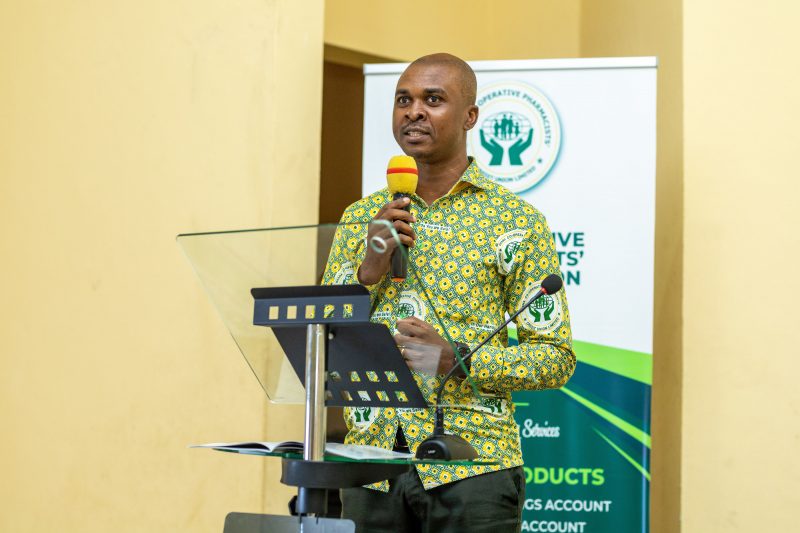
Dr. Paul Owusu Donkor is a distinguished figure in the field of pharmacy. He is a Pharmacist, Senior Lecturer, and a leading researcher at the University of Ghana School of Pharmacy. He holds the position of Head of Department for Pharmacognosy and Herbal Medicine. He is also a BOD Member of the GCPCUL, a position he has held since 2021. Before assuming the role of BOD Member, Paul had previously served as Supervisory Committee Member of the Students Savings Club (2004–2006) and member of the GCPCUL AGM Planning Committee (2020 to date). Dr. Paul Owusu Donkor is a multi-faceted individual who significantly influences the fields of pharmacy, research, and welfare of teams. His work not only benefits academia but also resonates with practical applications in public health and the marketplace.
1. Kindly tell us about yourself.
My name is Paul Owusu Donkor. I am a native of Kumi in the Atwima Nwabiagya district of the Ashanti Region of Ghana. I am the second of four children to my parents and had my basic education Calvary Temple A/G School in Kumasi. It was in primary school that I earned the nickname Paullowa (Paul is tall) because of my tall and lanky structure. I always wanted to be a lawyer, but my parents preferred that I read science, and that is what began my journey into becoming a pharmacist today. I had my secondary education in Opoku Ware School (2000-2002), tertiary in Kwame Nkrumah University of Science and Technology (2003-2011) and PhD in Tianjin, China (2013-2016).
After my training as a pharmacist at the KNUST, and practice at LaGray Chemical Company as Research Scientist and Medical rep for 3 years, I transitioned to academia where I lectured at the University of Ghana School of Pharmacy. After my PhD, I moved to the University of Health and Allied Science where I worked with Prof. TC Fleischer in building the UHAS School of Pharmacy, before finally returning to the University of Ghana School of Pharmacy where I currently work.
2. Can you walk us through your time as a member of the GCPCUL, beginning from the circumstances that culminated in your membership, your most memorable experience(s) with the Union and eventual membership on the BOD?
At the time I applied to study in KNUST, I was still not familiar with the prospects the pharmacy profession portended. I was therefore wont to engage my seniors in knowing how to order my steps in my training. It was in one of such engagements that Philip Tagboto, the then president of the Students Savings Club introduced me and my colleagues to the GCPCUL (the mother body of the Pharmacy Students Savings Club). Such was our commitment to the movement that my roommate, Emmanuel Boachie became the Students Savings Club president and I also got elected as a supervisory committee member (I was also the Editor of the GPSA at this time). In my tenure, Mr. Guat, the longest serving General Manager of the GCPCUL used to visit us every semester and offered capacity building opportunities for all executives. Imagine my amusement, when after several years I became a BOD member to Mr. Guat!
After school, I had little engagement with GCPCUL. It was in the COVID-19 era that Rev. Dennis Awitty invited me to assist him in planning a virtual AGM for the GCPCUL (he was the Chairman of the AGM Planning Committee). I got interested in the workings of the GCPCUL and devoted my time to engaging in its activities. I had no hesitation when the BOD invited me to serve as a member after a seat at the BOD became vacant.

3. How have those experiences in GCPCUL shaped and guided your decisions as a BOD Member?
The experiences (as supervisory committee, AGM Planning Committee and BOD member) have firmed up in me the conviction that one ought to take up leadership roles (rather than sit on the fence) to shape the course of history. There’s nothing to be afraid of in “dirtying your hands” in your service to your fellows.
4. What nuggets of wisdom would you like to share with GCPCUL members, so they maximise the benefits of membership?
I believe in the maxim that one must “use another’s money to make your own wealth” to be a truism. Young professionals should cultivate the habit of saving with the credit union so they build up their credit rating for taking up loans for future capital investments. The best time to plant a tree is years ago, and the next best time is now. Start and growing your active participation in the credit union movement for it pays well in the long run.
5. What recommendations would you make to the next BOD of the GCPCUL to make the union even better?
As a current BOD member myself, I think that the GCPCUL is on the right path in embracing technology and digitalisation in its operations. We should also pay attention to the pipeline of our membership. Students in the healthcare training institutions are a lower hanging fruit for our membership, and there is need to expend some energy and building the culture of savings and credit unionism in them before they leave school. You are doing very well for yourself and for your country in Education and Academia
6. What are the highlights (highs and lows) of your professional journey?
I have had a good career so far. It was Prof. Charles Ansah who first enlisted me to serve on the Scientific Committee of the PSGH even before I became a registered pharmacist. My service in the PSGH has brought me into contact with notable colleagues who have helped to shape my professional career. It is always a joy to see my students excel and blaze trails in different facets of life. Occasionally, they send me messages or mention me on different platforms, and these gestures well up a sense of pride in the path I have chosen to train up the next generation. In terms of low points, I try not to dwell on disappointments.
7.What has been your key driving force to coming this far?
I would say that my guiding philosophy in life has been to improve to impart for impact. At every given opportunity, I want to see either or all these action words in my life. I must improve on myself, because it is impossible to have fruits without roots; I must impart others with what I have for it is more blessed to give; my impartation must yield impact, so it is necessary to follow up on the seeds sown to guarantee growth and fruitfulness. Suffice to say, that it all comes down to my desire to pursue excellence, discipline and the unmerited grace of God.
8. What do you enjoy most about your work?
My work in the university is threefold. I teach (lecture), research and perform administrative functions. I enjoy engaging my students in meaningful intellectual discourses and often get amazed at some of the mind-bending thoughts that some of my students share every once a while. It is rewarding when you see the excitement of your project students as they make a discovery or surmount daunting scientific obstacles in the lab. These experiences give me a thrill.
9. What tweaks are needed to ensure that the impact of pharmacy education is tangibly felt in the country and beyond?
I am concerned about the over-concentration of our training on hospital practice. PharmD is a positive development in pharmacy education, but it is fast becoming a strait jacket where the other fields of our practice are starved of suitable human resource. We cannot grow our presence in manufacturing, marketing, academia, regulation etc if we continue to tailor our training towards hospital practice only.
10. If you could do it all over again, what would you do differently?
It has been an exciting journey so far. I have made some good and not so good decisions, but I am confident that the sum of these decisions have brought me thus far. I am happy with what I have been able to do by the Grace of God. As they often say in love songs, if I had to do it all over again, I choose this same path.




Great piece, full of many nuggets of wisdom.
Thank you for the great work done.